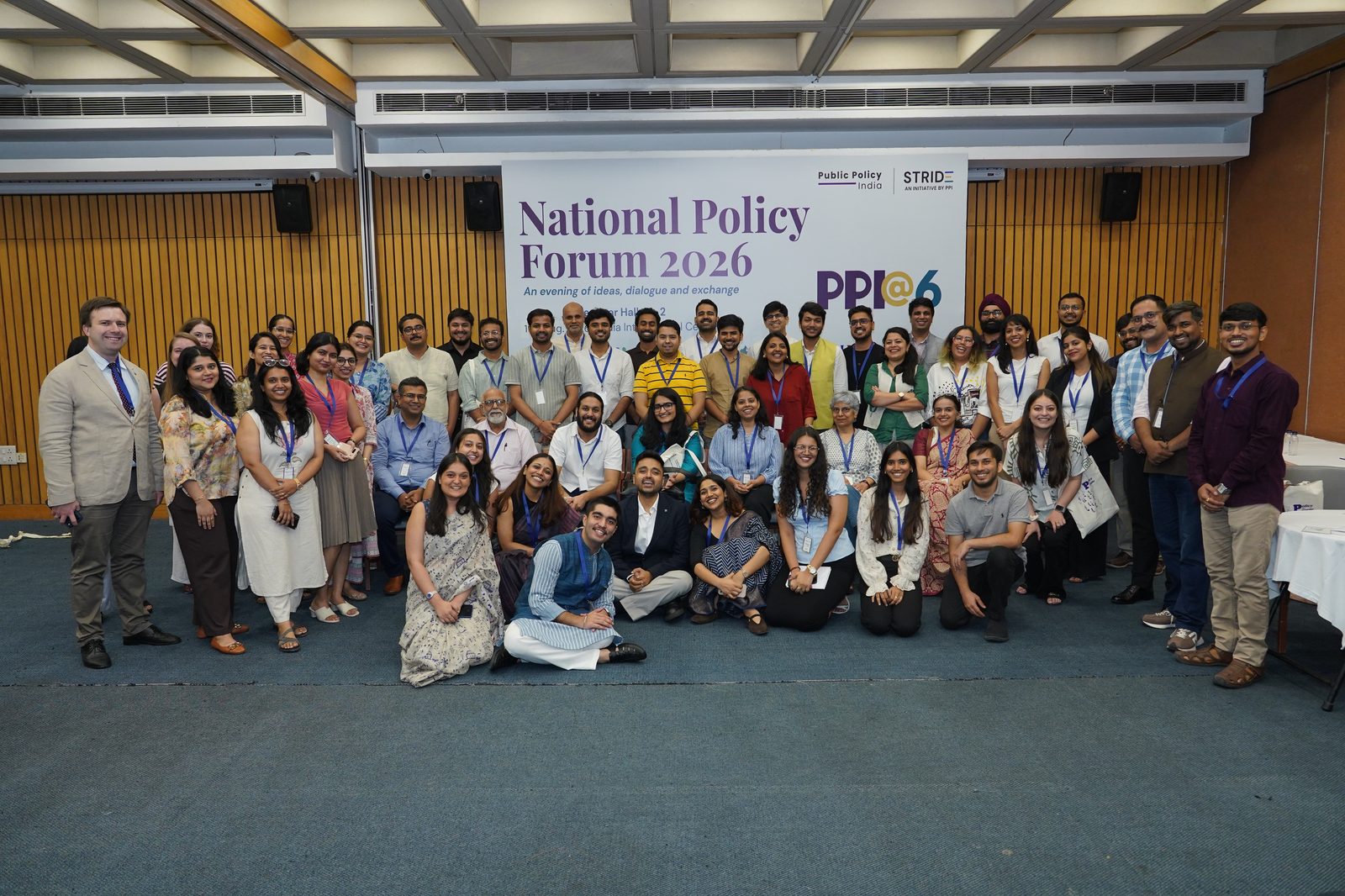

A whole generation is walking into policy. We built the room where it gathers.
Public Policy India is the first, the largest and the most vibrant pan-India community of public policy professionals, students and institutions. Since 2020 it has grown into a network of 150,000+, sector-agnostic and open to all, spread across the country. STRIDE, our youth-policy think tank, sits on top of that community and carries its perspective into research, capacity building and counsel for the institutions shaping public life. What began as a community has become the infrastructure for policy engagement in India.
Why now
The largest young workforce in history. The smallest pipeline into governing it.
India will carry the largest working-age population on earth through the 2030s, and the institutions that shape public life will need far more trained people than the formal pipeline produces. Around 60 postgraduate policy programmes graduate only a few thousand specialists a year,* while government carries millions of vacancies and private demand keeps climbing. Think tanks publish research. Universities credential graduates. Consultancies serve clients. No one in India is in the business of widening the policy talent pipeline at scale, in plain English, for free, in the cities and towns where the talent actually lives.
PPI builds that bridge. STRIDE puts it to work.
*Roughly 60 master's programmes in public policy across India. Diploma, degree, certificate and undergraduate programmes are additional.
The opportunity, in numbers
How it fits together
One community. Three lines of work.
Community Engagement
City chapters across India's largest cities, regular in-person meetups we call Policy Circles, a weekly newsletter that works as a hub for everything to do with policy careers, and Polis, our platform for civic engagement. Open to all, always. This is how we hold the community together.
Inside the community → STRIDECapacity Building
Fellowships, workshops, curricula, tools and databases for people who want to go deeper, from school students to mid-career practitioners. This is where we teach the craft of policy.
See what we build → STRIDEConsulting and Research
Applied research, policy communications and engagement capability for institutions, delivered with a youth lens you will not find elsewhere. This is how a partner reaches young India, and acts on what it learns.
Work with STRIDE →Evidence, not adjectives
What that reach actually does.
150,000+ members, 40+ city chapters
Across India's 25 largest cities, with a 22,000+ reader newsletter and 80,000+ followers across LinkedIn and Instagram. Over half the community sits outside Delhi, Mumbai and Bengaluru.
India's first and largest policy community
Pan-India, sector-agnostic and high-trust. Gender-balanced by design at 55.6% women, with 80% under thirty. Everything for the community is open to all.
35+ universities, 130+ in-person engagements
80+ Policy Circles and 50+ university teaching sessions, 130+ in-person engagements across 20+ cities over six years, run with partners across the ecosystem rather than for any single name.
For you to explore
Some of our products and initiatives
Trusted across the ecosystem
Every domain that touches policy in India
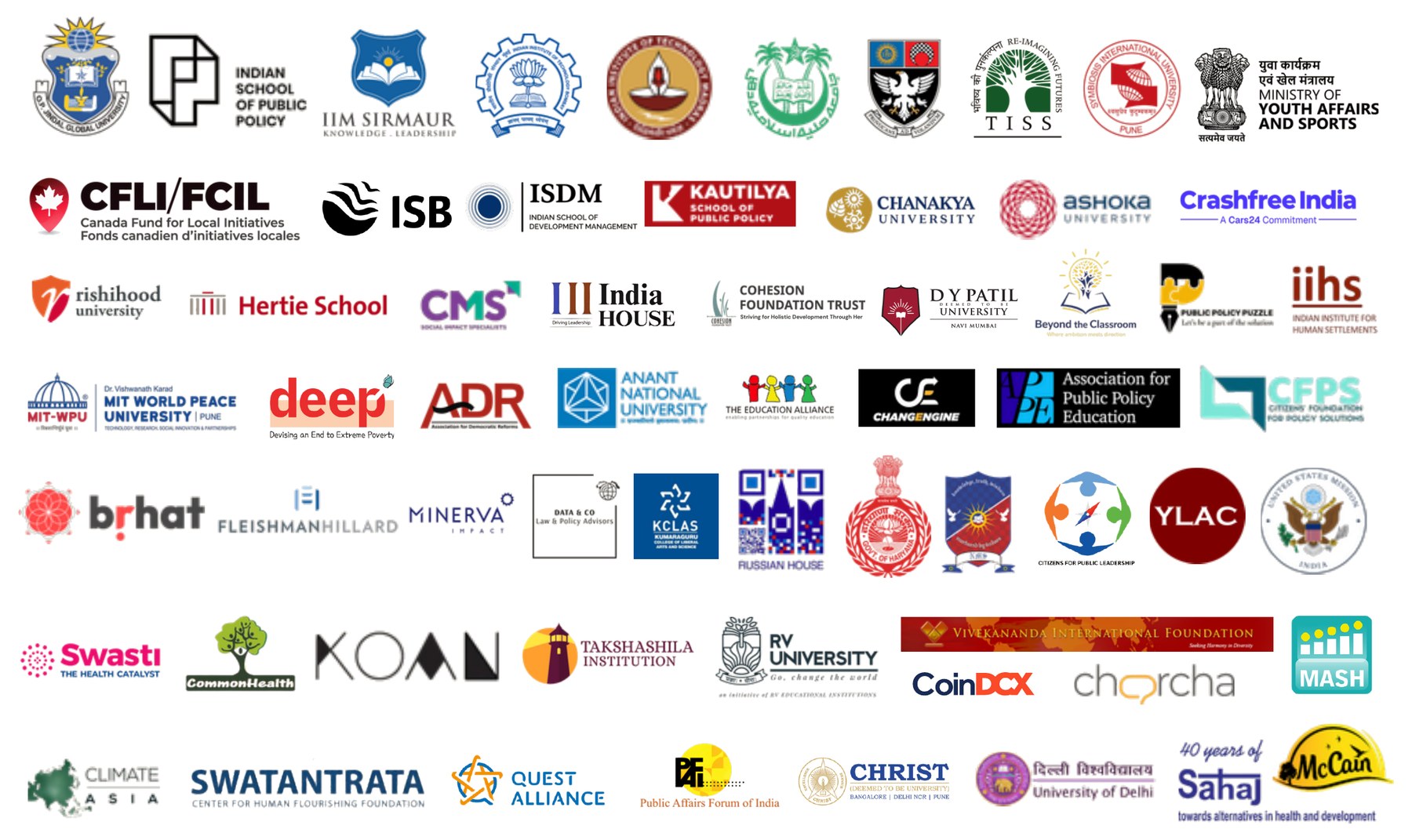
A selection of the institutions we work with, from national universities and policy schools to think tanks, foundations, social-impact organisations, companies, embassies and government bodies across India and South Asia.
Public Policy India and STRIDE partners include Takshashila Institution, Swasti, The Better India, Rebounce, Indian School of Development Management, IMPRI (Impact and Policy Research Institute), India House, Cohesion Foundation Trust, Citizens for Public Leadership, Indian School of Public Policy, Public Policy Puzzle, Hertie School, University of Delhi, Beyond the Classroom, O.P. Jindal Global University, Chanakya University, Ashoka University, Crashfree India, Citizens' Foundation for Policy Solutions, Tata Institute of Social Sciences (TISS), Quest Alliance, Vivekananda International Foundation, Koan Advisory Group, Minerva Impact, Christ (Deemed to be University), Indian Institute of Technology Madras, Rishihood University, Jamia Millia Islamia, Young Leaders for Active Citizenship (YLAC), FleishmanHillard, MIT World Peace University, ChangeEngine, Sinceriti, U.S. Mission India, CoinDCX, Catalyst Management Services (CMS), Government of Haryana, Kautilya School of Public Policy, Anant National University, Project DEEP, Brhat, Association for Public Policy Education (APPE), Indian Institute of Technology Bombay, D Y Patil University, Navi Mumbai, Indian School of Business (ISB), Russian House, CommonHealth, among 75+ partner institutions across India and South Asia.
If your work depends on engaging young Indians who care about policy, this is the front door.
Alongside engaging India's youth on the importance of policymaking and building meaningful careers here, one of PPI's core goals has always been to lend structure to India's fast-growing public policy and social impact space. This is so that partner institutions can engage a high-trust community across the entire ecosystem and accomplish a range of outcomes in a far more streamlined manner. For years, universities, funders, think tanks and mission-driven institutions have worked with PPI for trusted access and with STRIDE for research, communications and capacity building. Tell us what you are trying to move.
About
Who we are
We built the community we wished existed
Public Policy India was founded on a simple belief: policy should be more accessible, to those already working in the field, and just as much to those trying to understand it, enter it and contribute to it.
From a conversation to infrastructure
We set out to create a space where a first-year undergraduate in Guwahati, a researcher in Delhi, a development practitioner in Bengaluru and a policy professional in Nagpur could all participate in the same conversation. Founded on 15 August 2020, Public Policy India has grown into one of the country's largest policy platforms, connecting individuals, institutions and opportunities across India.
What began as a community has become an infrastructure for policy engagement.
A bridge between people and institutions
PPI serves demand on both sides. On one side, hundreds of thousands of young Indians who want guidance, community and opportunity to discover and enter the policy space. On the other, the institutions that shape it: think tanks, consulting firms, governments, foundations and policy schools that want to recruit from, build with, understand and reach this generation.
Community Engagement
City chapters, in-person Policy Circles, the weekly newsletter and Polis, our civic-action platform. The parts that hold the community together, open to everyone.
Explore → Pillar 02Capacity Building
Fellowships, workshops, curricula, tools and databases for people who want to go deeper, from school students to mid-career practitioners.
Explore → Pillar 03Consulting and Research
Applied research, policy communications and institutional engagement, delivered through STRIDE with a youth lens.
Explore →From school student to sector leader
This young cohort of policy enthusiasts as well as professionals is increasingly gaining influence in India's broader governance and impact ecosystem, and it is a trend only on the rise.
Most students never hear that policy is a career until far too late. We get there early. PPI Talks goes into classrooms, and The Policy Post and the Policy Career Navigator put the whole field in a student's hands, so a teenager can see a path long before they have to choose one.
- PPI Talks
- The Policy Post
- Policy Career Navigator
This is where most people find us. Through Policy Circles, our city chapters and PPI Talks on campus, a student in any of 25+ cities can walk into a room full of practitioners, and the career databases turn a first spark of curiosity into an internship or a fellowship.
- Policy Circles
- City chapters
- PPI Talks
- Career databases
- ebooks
The first few years are the hardest. We help people turn interest into craft. Policy Sangam, our flagship fellowship, takes a cohort deep into real policy work, while Policy Circles, The Policy Post, Policy Panchayat and the wider community keep them learning, connected and in the room as they find their footing.
- Policy Sangam
- Policy Circles
- The Policy Post
- Career databases
- ebooks
By now the relationship runs both ways. Practitioners speak, mentor and hire through the community, and PPI Executive, our closed senior network, brings them together at quarterly gatherings in Delhi, Mumbai and Bengaluru.
- PPI Executive
- Speaking and mentoring
- Quarterly gatherings
Those who have shaped the sector stay close, as advisors, mentors and friends of the work. Many mentor younger members coming up behind them, guide STRIDE's commissioned research, and sit on our Board of Advisors.
- Mentor young professionals
- STRIDE advisory
- Board of Advisors
What STRIDE is
STRIDE, the Strategic Research and Impact Development Enterprise, is a new-age think tank shaping India's youth policy aspirations. It was created as PPI grew and institutions began asking how they could go deeper. Foundations want to reach the community. Universities want to build with it. Governments want to understand it. Think tanks want to collaborate with it. STRIDE brings consulting, research and institutional engagement to the ecosystem PPI had spent years building, across three lines: Research, Consulting and Capacity Building.
One ecosystem, two brands
PPI builds trust. STRIDE translates it into institutional work. Every engagement STRIDE delivers is grounded in the same community that makes PPI credible.
See STRIDE's consulting services →PPI and STRIDE, working as one
PPI builds trust; STRIDE turns it into institutional work. Together they let a partner convene exactly the people they need to reach, through a community that is high-trust, gender-balanced, sector-agnostic and pan-India, and turn those forums into long-term institutional outcomes. Every STRIDE engagement is grounded in the same community that makes PPI credible.
People behind PPI and STRIDE
Yash Agarwal
Founder
Founder of Public Policy India and STRIDE. He works in global stakeholder engagement and internet governance at ICANN, has taught at several of India's leading universities, and has previously worked with X (then Twitter), Parliament, PRS and Chase Advisors.
Kashish Goyal
Lead, Research and Communications. Co-Founder, STRIDE
A communications and research professional with experience in legislative analysis and social-impact communication. Holds a BA in Political Science and Philosophy from Miranda House, University of Delhi, and works at the intersection of gender, mental health and inclusive development.
Manan Singh
Lead, Partnerships and Programs. Co-Founder, STRIDE
Leads PPI's partnerships and flagship programmes, including Policy Sangam, and builds the institutional relationships that carry the work forward.
Snehaa Rajesh
Lead, Community Engagement and Editorial
Leads community engagement and editorial across PPI, holding the city chapters, monthly Policy Circles and The Policy Post together, and keeping the community active across more than 25 cities.
Guided by leaders across policy, business and social impact
PPI's Board of Advisors brings together senior practitioners who guide our thinking, open doors and hold us to account. Their presence reflects the trust this community has earned.
Be part of what comes next
Whether you are starting out, building a career, or leading an institution, there is a place for you in this community.
Community Engagement
80+ Policy Circles. 20 cities. Six years of showing up.
The Policy Circles, the City Chapters, the newsletter and the platform: this is where it all comes together. An open, pan-India, high-trust community where students, practitioners and institutions meet, in person and online, sector-agnostic and built around a simple belief that more young people belong in policy. Most members travel the same arc: discover, find clarity, take part, and go on to lead.
Everything that holds the community together
City chapters
40+ city chapters across India's 25 largest cities, each with its own city-level WhatsApp group where opportunities, events and questions move in real time. The idea is simple: to seed a local and regional policy ecosystem in every part of India.
Find your city → Free and in personMonthly Policy Circles
Open, free, in-person gatherings every month. We have hosted 80+ Policy Circles across India's 20 largest cities over the last six years, each one a room of conversations, networking and speakers from across the policy ecosystem.
See the latest → Every FridayThe Policy Post
PPI's weekly newsletter: hundreds of jobs, internships, fellowships, learning modules and the week in policy. Free, no spam, delivered every Friday morning.
Subscribe → On YouTubePolicy Panchayat
PPI's YouTube series: regular, honest conversations with practitioners, policymakers and experts about how policy actually works. Free to watch, anytime.
Watch on YouTube → All in one placePolis
The all-in-one PPI platform: take real civic action, get it verified, climb the leaderboard and reach your representatives, in a single home.
Open Polis → Volunteer-ledCity Chapter Leaders
Local volunteers who run each chapter on the ground: hosting Policy Circles, welcoming new members and keeping the conversation going between events.
Meet the leaders → Member spotlightsPathfinders, Showcase and Spotlight of the Week
Recurring features that surface members' journeys, work and milestones across the community.
Explore the features → For senior practitionersPPI Executive
A closed network of senior and mid-career practitioners, with quarterly gatherings in New Delhi, Mumbai and Bengaluru.
Express interest →Chapters across India
From the metros to fast-rising cities, our chapters span 25+ cities across India. Tap any city to find and join its WhatsApp community.
The people who run the chapters
Every chapter is led by a City Chapter Leader: a volunteer who hosts Policy Circles, welcomes new members and keeps the conversation going between events. It is the most hands-on role in the community, and the most visible. Leaders build a public profile in the policy ecosystem, a network across cities, and the kind of judgement that only comes from running real events and bringing people together. We are growing the team. If you want to represent PPI in your city, this is where it starts.
What you do
Host monthly Policy Circles, grow your city's chapter, and connect members to opportunities across the network.
What you gain
A visible leadership profile, a network across India's policy ecosystem, and real skills in events, community and stakeholder engagement.
What it takes
Reliability, warmth and a genuine interest in public life. No prior policy background required, just the will to show up for your city.
Become a leader →Meet some of the people behind our chapters
Some of the people who hold PPI together in their cities.
Amal Saji
Kerala City Chapter Leader
Amal Saji is a public policy practitioner working at the intersection of child rights, governance and institutional reform. His work focuses on translating grassroots challenges into evidence-informed policy interventions, contributing to systemic improvements in child protection, education and public service delivery. Several of his interventions have informed administrative directions and institutional reforms aimed at strengthening child-centric governance.
Sagar Narayan
Lucknow City Chapter Leader
Sagar is a climate policy and international development researcher with over four years across climate governance, education and sustainable development. He holds an M.Phil and was a PhD researcher at the Central University of Gujarat, and has worked with IIT Kanpur, a NITI Aayog project and Uttar Pradesh's NIPUN literacy mission. He leads PPI in Lucknow.
Tanya Saxena
Bhopal and Indore City Chapter Leader
A lawyer by training and a systems thinker by inclination, Tanya works at the intersection of policy, product and institutional reform. She is in public policy at Navi, and previously worked with MeitY and the Government of Madhya Pradesh.
Girish
Chandigarh City Chapter Leader
Girish is an innovation consultant with a background across engineering, tech strategy and public policy. He has worked in policy consulting, political advisory and civil-services mentoring, and leads PPI's Chandigarh chapter.
Nilanjana Bhattacharjee
Kolkata City Chapter Leader
Nilanjana is a public policy professional working across tech governance, democracy and development. Her work spans government advisory, research and monitoring and evaluation, with a focus on the SDGs, and she is also a co-founder, writer and animal-rights advocate.
Ankit Priya
Hyderabad City Chapter Leader
For Ankit, public policy is about solving the everyday problems people face: a child learning well, a commuter getting home on time, a farmer earning a better living, and a government that works. A first-principles approach has guided his work, with a focus on helping systems deliver better outcomes. He is Research and Advocacy Lead at the Foundation for Democratic Reforms.
Not just a following. A community.
A newsletter open rate several times the typical industry range, and a WhatsApp read rate above 80% verified from receipts, are both rare at this scale. This is what trust looks like in the numbers.
Who is in the room
What the community says
I remember moving back to India after working in government and realising there was no single centralised platform to find roles in policy. Yash is the Tom Manatos of India's public policy space.
PPI played a huge role for me by providing network and community remotely. The access to information from the newsletter and group chats was very comforting. I have just started my career in policy as an intern in Delhi.
I have collaborated with the PPI community for nearly three years across public policy programmes. What makes the PPI family special is its commitment to a strong community of future policy professionals and changemakers.
PPI over the past six years has done a great job demystifying public policy careers. By bringing people together and sharing information across different channels, PPI is filling an important gap.
Find your people
Subscribe to the newsletter, join your city's chapter and come to a Policy Circle. It is free, and it is open.
Capacity Building
Building careers, not just conversations
Teaching and workshops across 35+ universities and schools. The Policy Career Navigator, databases, tools and courses. Policy Sangam, our annual flagship fellowship. Built for people who want to learn, upskill and grow. We teach the craft of policy.
Teaching the craft of policy, in person and at scale
Capacity building is where PPI does the slow, direct work of teaching policy. Over the last few years we have run 50+ in-person teaching and workshop sessions across 35+ universities and schools in 20+ cities, and the count keeps climbing.
The formats range from two-hour guest lectures to thirty-hour credit-bearing courses, alongside fellowships, self-paced tools and open databases. Some of it reaches school students in Classes 11 and 12; some we design with partner institutions across the ecosystem. The aim stays constant: take someone curious about public life and give them the knowledge, skills and network to build a real career in it.
Tools, training and resources, all in one ecosystem
Policy Career Navigator
Your roadmap into India's policy ecosystem: 100+ careers mapped across 12 domains. Free to use.
Open the tool → 35+ universitiesPPI Talks
Workshops and guest teaching across schools and 35+ universities, plus international virtual sessions.
See it on LinkedIn → India's dataMany Indias
An interactive tool that maps living conditions across India, bringing data to life for students and researchers.
Open the tool → Self-pacedKnowledge Resources
E-books, guided toolkits and sector primers that explain the field, step by step.
Browse resources → CuratedDatabases
Fellowships, policy organisations, policy schools, scholarships and short courses, all in one place.
Browse the databases →Working across the ecosystem
A large part of our teaching happens through deep, ongoing partnerships: inside universities, in schools, and alongside other institutions across the ecosystem. This work runs along several lines.
Board of Studies and advisory roles
STRIDE holds standing Board of Studies seats and academic advisory roles at partner universities, helping shape what policy and governance curricula actually teach.
University MoUs and partnerships
Formal teaching and curriculum partnerships with universities across India, with more in the works.
Workshops and guest teaching
In-person workshops, guest lectures and full courses on campus, from single sessions to credit-bearing modules, meeting students where they already are.
School programmes
We run sessions for school students, especially in Classes 11 and 12, introducing policymaking, governance and the idea of a meaningful career in public life early, when students are first choosing their paths.
Capacity building with partner institutions
We also design and deliver capacity-building programmes with and for other institutions in the ecosystem, including think tanks and research organisations, taking our teaching well beyond the university classroom.
A bridge into the wider ecosystem
We plug partner universities and their students into the PPI community, the city chapters, The Policy Post and Policy Circles, so what they learn turns into real career outcomes.
Partner with us →Policy Sangam
Policy Sangam is PPI's annual flagship capacity-building programme for early-career talent. Each cohort moves through an online programme across several thematic tracks, combining live teaching, mentorship and hands-on work on real policy problems, and comes together for an in-person residential retreat. It is where an interest in policy becomes craft, and where a cohort becomes a network that lasts well beyond the programme.
Do more than attend
Use the Career Navigator, explore the databases, and put the tools to work. Everything we build is free for the community.
Consulting and Research
Consulting grounded in community
As PPI grew, institutions began asking how they could go deeper. STRIDE, a new-age think tank shaping India's youth policy aspirations, works with foundations, governments, IGOs, think tanks and corporates, from focused research commissions to multi-year retainers. We serve partners who serve India, to deepen institutional engagement.
Eight service lines, one capability
Community and consulting, working as one
Every piece of consulting STRIDE delivers is grounded in the same community that makes PPI credible. When a foundation needs to reach young Indians, when a government body needs a brief that lands, or when a university needs an outreach partner, STRIDE brings both the analytical capability and the trusted access in one relationship.
From scoped project to embedded partner
Most relationships begin with a single service line and grow from there. Engagements range from time-bound research commissions to long-term retainers that embed PPI and STRIDE in a partner's strategy.
See the four ways partners work with us →Some of the work we are most proud of
Each engagement is different, and each is rooted in the same expertise and community access.
Trusted by the institutions we work with
I have had the opportunity to collaborate with the PPI community for nearly three years across various public policy programmes. PPI has consistently connected us with some of the most talented and aspiring individuals looking to build careers in public policy and governance, and what makes it special is its commitment to nurturing a strong community of future policy professionals and changemakers.
PPI over the past six years has done a great job demystifying public policy careers. By bringing people together and sharing information through different channels, PPI is filling an important gap.
Public Policy India has been a valuable outreach partner in helping us introduce development management as a meaningful career pathway. Their engaged community created an excellent platform for ISDM to showcase opportunities in the development sector, and we appreciate their support in connecting aspiring changemakers with purpose-driven career possibilities.
PPI has been an important companion in Cohesion's organisation-development journey over the last two years. Their facilitation enabled us to sharpen our strategic direction and bring greater visibility to the rich body of work that Cohesion has built over 25 years.
Engagements with global institutions
STRIDE has supported international institutions seeking to engage India's youth policy community and ecosystem, including work with the U.S. Mission to India and the Russian House. Programme and capacity design is delivered both in person and virtually, across borders.
Tell us what you are working on
Whether it is a scoped research commission or an embedded, long-term partnership, the conversation starts the same way.
Research and Publications
Research from where the community is
STRIDE's research bench produces applied research, sectoral analyses and synthesis, grounded in the pan-India community of stakeholders across the ecosystem. New publications are on the way. Subscribe to be the first to read them.
The State of Young India in Policy
Our first flagship report, drawing on PPI's community survey and field engagement, offers a data-backed picture of who India's young policy aspirants are, what they want, and where the gaps lie. It is anchored to 15 August 2026, PPI's sixth anniversary and India's Independence Day. A survey brief accompanies the launch.
What it will cover
Who is entering the policy field, from which backgrounds and cities; what they study and aspire to; the structural gaps between demand and opportunity; and what institutions can do about it.
Be notified at launch →What STRIDE research does
A standing research capability for partners and for the public record, spanning four kinds of work.
Applied research
Field-grounded studies that answer practical questions for institutions and the sector.
Sectoral analyses
Deep dives into specific domains, from social protection to digital governance.
Briefs and synthesis
Policy briefs, budget analysis and evidence synthesis, structured for decision-makers.
Survey and community data
Original survey work and Youth Pulse reports drawing on one of India's largest and most policy-aware youth communities.
We have done this at scale
Public Policy India runs surveys across its community every week, on a range of policy, governance and career questions, and draws thousands of respondents from across India each time. Because the community is focused rather than generic, sector-agnostic, truly pan-India and gender-balanced, it lets us read the pulse on a subject with a clarity few institutions can match. That real-time, accurate picture informs the work we and our partners do across the ecosystem.
A growing library
We are fast building out our library of publications. This is a work in progress: flagship reports, sector primers, survey briefs and working notes from the STRIDE research bench will land here over the coming cycles. Want first read, or to commission a piece of research? Get in touch.
Read it first
Subscribe to The Policy Post and you will be among the first to receive new STRIDE research as it publishes.
Career Resources
Free and open to all
Your roadmap into India's policy ecosystem
Everything you need to find your way into policy and social impact, in one place and free: a careers navigator, curated databases, a weekly jobs board, your city chapter, conversations with practitioners, and guides that explain the field.
Policy Career Navigator
A practical map of the field: 100+ careers across 12 domains, with what each role involves, who hires for it, how to get there, and how much it pays. Built for students and early-career professionals trying to understand where they fit.
Curated, searchable, free
Years of curation, kept current, so your search does not start from scratch. Each database opens in its own space; cover images and links are being added.
Hiring organisations
Think tanks, consultancies, foundations, government bodies and more, across the policy and social-impact ecosystem.
Link coming soonFellowships
Policy and social-impact fellowships in India and abroad, with what each offers and who it is for.
Link coming soonScholarships
Funding routes for policy and governance study, curated for Indian aspirants.
Link coming soonPolicy schools
Policy schools and programmes, Indian and international, side by side.
Link coming soonShort courses
Short courses in policy and governance for focused, flexible upskilling.
Link coming soonGrants and funding
Grants and funding routes for people and organisations doing public-interest work.
Link coming soonOpportunities, every week
The databases are only part of it. Four more ways the community puts real opportunities in front of you.
A weekly jobs board in your inbox
Every week, The Policy Post shares hundreds of new jobs and internships from across the public policy and social-impact world, curated and sent straight to you.
Subscribe free → In your cityOpportunities where you are
Your city chapter surfaces new ways to do meaningful work in policy and social impact right where you live, from local roles to on-ground projects and events.
Find your chapter → On YouTubeLearn from people who did it
Policy Panchayat and our channel bring you conversations with practitioners and experts across the ecosystem, on how they built their careers and what they learned along the way.
Watch → GuidesGuides that explain the field
In-depth e-books and primers that break down the sector and how to build a career in it, free to read.
Read the guides →Start where you are
Open the Navigator, browse the databases, and subscribe for weekly opportunities. No cost, no catch.
Polis by Public Policy India
Become an agent of civic change
Reading about policy is the start. Polis is where you act on it: file the complaint, use your rights, show up, and put your city on top. Log every action you take, climb the ladder, and see the community move. Free to use.
One action looks small. A community's doesn't.
One RTI rarely moves the system. Ten thousand do. Polis turns single civic actions into collective weight: every complaint filed, right used and consultation answered, logged and counted across a 150,000-person community. The results will come, and the potential is the point.
Act, log, climb
File one RTI this month
Pick one thing you have always wanted to know: a road budget, a pending application, a public contract. File a single RTI and log it. If every active member did this once, that is tens of thousands of questions the system has to answer.
The chapter leaderboard
Every action a member logs counts for their city. Polis opens to the community alongside the new site, and this is where the chapter standings will live, updated by chapter leaders. Be among the first to put your city on the board.
Want your city higher? The fastest way up is to act and bring your chapter with you.
Civic Champions of the month
Members who go further than most, chosen each month by the team. Once Polis is live, this is where their work will be recognised.
Recent wins
Five tiers. No fees to unlock. Earned by actions.
Every action earns points. Points move you up the ladder. The reward is recognition, a badge, a place on the board, a spotlight, not anything you have to pay for or chase.
Your move
Pick one action. Do it this week. Log it. That is how a citizen becomes an agent of change, and how a city climbs.
Dashboard / Act & track
Act & track
Do the thing. Log it.
Use the toolkit below to take a real civic action, then log it. Your points and your tier move on the spot, and every verified action counts toward your city.
Every action, counted
Create a free civic account, then log each action with a reference number or a short note as proof. A chapter leader reviews it, and once it is verified it counts toward your score, your tier and your city. Your score is real and checked, not self-declared, and it is yours to carry.
Create your civic account
Sign in with your email. We send a one-time code, so there is no password to remember. The account is what makes your score verifiable.
Your city is used only to total your chapter's standing. It is never shown against your name.
Your submissions
How to actually do it
Pick an issue. You get the responsible authority, the law that backs you, where to file, and your RTI lever. Done it? Log it from inside the panel.
Polis points you to official government channels and helps you draft your complaint. It does not file on your behalf or track your complaint with the authority.
The levers that move files
Right to Information (RTI)
The Right to Information Act, 2005 lets any citizen ask a public authority for its records. File online for central bodies at rtionline.gov.in (the fee is usually Rs 10, and people below the poverty line are exempt). The officer must reply within 30 days. If they do not, you file a first appeal within 30 days; a second appeal goes to the Information Commission. For state departments, use your state's RTI portal.
CPGRAMS, the central grievance portal
CPGRAMS (pgportal.gov.in) is connected to every central ministry and state government. It is free, open 24x7, and gives you a tracking number and an appeal option. Use it when the responsible authority has not acted within its own timeline. The target for redressal is 21 days. It is also on the UMANG app.
The escalation ladder
The same five steps work for almost any public service. Each rung leaves a paper trail the next one can use.
Complaint builder
Fill in three boxes and Polis writes a clean, formal complaint you can copy into the portal or paste into an email. Nothing you type leaves your device.
These are official Government of India and state channels. Helpline numbers, portal addresses and timelines change occasionally, so confirm the current detail on the official portal before you file. Electricity grievances follow the Electricity Act, 2003 (Consumer Grievance Redressal Forum, then the Electricity Ombudsman); consumer cases follow the Consumer Protection Act, 2019; information requests follow the Right to Information Act, 2005.
Dashboard / Engage
Engage
Go beyond the complaint. Shape the system.
Fixing what is broken is one half of citizenship. The other half is shaping what comes next: the laws being written, the people who represent you, and the vote that puts them there. Here is how to use all three.
Have your say before a bill becomes law
Filing a complaint fixes today's problem. Commenting on a draft law shapes tomorrow's. Under the Pre-Legislative Consultation Policy, 2014, central ministries are meant to place draft bills, rules and regulations in the public domain for at least 30 days, alongside a plain-language note on what the law does and why, so any citizen can read it and send comments before it goes to Cabinet.
Your comment can actually change the law
This is not a suggestion box. On one platform that routes citizen feedback to government, 52% of the comments collected on the draft Transgender (Protection of Rights) Rules were reflected in the final law, and across consultations they report roughly 30 to 70 percent of community feedback finding its way in.
MyGov consultations
The Government of India's platform, in 12 languages, where ministries post draft policies and bills for public comment. You register to submit your views.
Open MyGov → Plain languageCIVIS
A non-profit that lists open consultations, explains each draft in plain language, collects your feedback and passes it to the right department.
Find a live consultation → TrackPRS Legislative Research
Independent, non-partisan summaries and tracking of every bill in Parliament, including which ones are before a committee for scrutiny.
Track the bills →When a bill is referred to a Parliamentary Standing Committee, that committee can invite written memoranda from the public, so watch for its press notice. State assemblies vary, but several now publish draft legislation for comment too, often through the same platforms.
The 30-day public-comment window is policy and is not always followed, which is exactly why citizen participation matters. The incorporation figures are from a civic-tech platform's own published experience and vary from one consultation to the next.
Reach your representatives
You have representatives at three levels: in Parliament (your Lok Sabha MP, and your state's Rajya Sabha MPs), in your state assembly (your MLA), and locally (your municipal councillor, or your Gram Panchayat). Their contact details are public. Most of them rarely hear from the people they represent, which is exactly why a clear, specific message lands.
Find your representative first
Not sure who your MP or MLA is? Search the electoral roll on the Voters' Services Portal. It shows your Assembly and Parliamentary Constituency, and you then look that name up in the directories below.
Your MP
The official Lok Sabha directory on the Parliament website: every sitting member, their constituency and contact.
Open the directory → Rajya SabhaYour state's MPs
The official Rajya Sabha directory. These members represent your state in the upper house, on six-year terms.
Open the directory → Find themYour constituency
Search the electoral roll to confirm which Parliamentary and Assembly Constituency you fall in, then match it to your MP and MLA.
Look it up → Hold them to itTrack their work
PRS Legislative Research shows an MP's attendance, questions asked and debates joined. See whether yours turns up.
Track on PRS → Their recordKnow their record
MyNeta, by the Association for Democratic Reforms, compiles the declared assets and any criminal cases of candidates and members.
Check MyNeta →Your MLA & councillor
For your MLA, your state Legislative Assembly website carries the member list. For local issues, your municipal corporation or panchayat lists its ward members.
How to write so they read it
Keep it to one issue. Open with your name and that you are a constituent, and name your area. State the problem in two lines, then exactly what you want them to do: raise a question in the House, write to the ministry, or visit. Be firm and courteous. A single page is plenty.
Contact details on the official portals are maintained by the Houses themselves. Lok Sabha membership changes at a general election, the next due in 2029; the Rajya Sabha changes in parts, with about a third of its seats every two years, so these directories rarely need checking in between.
Vote, and show up
The most basic civic power is the vote, and it lapses the moment your name slips off the roll. Beyond elections, the nearest democracy is your Gram Sabha or ward committee, where local budgets and works are actually decided, and where one informed resident can shift a decision.
Register or check your name
The Election Commission's Voters' Services Portal: register as a new voter, check or correct your entry, and download your e-EPIC.
Open the portal → AppVoter Helpline app
Register, find your polling booth, see candidate profiles, and lodge electoral complaints. The national helpline is 1950.
Get the app →Gram Sabha & ward meetings
Attend the open meeting for your village or ward. Ask what was sanctioned, what was spent, and what is pending. These bodies sign off on local works and welfare lists.
Portal addresses and app links occasionally change, so confirm the current detail on the official ECI website before you rely on them.
Small acts, compounded
One comment on a bill, one letter to your MP, one name kept on the roll. None of it is dramatic. All of it is how a country is actually run.